How to Score Step 2 NBME: Percent Correct, Score Reports, and Readiness
A practical guide to calculating your percentage, reading an NBME result, and using a score range without confusing an independent estimate with an official Step 2 CK score.

To score a Step 2 NBME, first calculate percent correct from your total and incorrect answers. Then read the official self-assessment report for its own score and performance context. A public calculator can provide a directional estimate, but there is no universal public formula that turns every percent-correct result into an exact official three-digit Step 2 CK score.
The phrase “how to score Step 2 NBME” hides several different questions. Some students want to calculate a percentage from missed questions, some want to understand an NBME score report, and others want to know whether a result suggests they are ready to schedule Step 2 CK. Those tasks are related, but they should not be treated as the same calculation.
What “scoring” Step 2 NBME actually means
A practice NBME result usually has at least three layers: the arithmetic percentage, the assessment’s reported score or performance measure, and the planning decision you make from that result. The first layer is simple math. The second depends on the assessment and its reporting system. The third should include uncertainty, your recent trend, and the rest of your preparation.
Percent correct is not automatically the same thing as a three-digit Step 2 CK score. Different assessments can use different item sets, difficulty distributions, equating methods, and score-report formats. That is why a screenshot or table from one form should not be presented as a universal conversion formula for every NBME form.
A safer workflow is to keep the three layers separate: calculate the percentage accurately, read the score report that came with your assessment, and use an independent calculator only as a directional planning aid. If a result is close to the current official passing standard, verify the standard and the reporting rules on the current USMLE pages before making a high-stakes decision.
- Raw arithmetic tells you how many items were correct; it does not prove an official scaled score.
- The assessment report is the primary source for the result attached to that specific form or product.
- A readiness decision should consider a range and a trend, not one isolated number.
Do not turn a percentage into a fake official score
Online tables can be useful for orientation, but they often combine different forms, different sample sizes, and different assumptions. Treat a table as a rough reference unless it clearly states its source, assessment form, date, and limitations.
This site’s calculators are independent educational tools. They can help you see a plausible range or compare recent results, but they do not replace an official NBME report, an official USMLE transcript, or advice from your school or licensing authority.
How to calculate percent correct from wrong answers
If you know the total number of scored items and the number you missed, use this simple calculation: percent correct = (total items − incorrect items) ÷ total items × 100. If your report already gives percent correct, use the report value instead of reconstructing it from a rounded number.
The arithmetic is only as reliable as the denominator. Confirm whether the assessment contains experimental items, omitted items, or a scoring rule that changes which questions count. When you are unsure, record the value shown on the official report and label any hand calculation as an estimate.
For example, 30 incorrect answers out of 200 items gives 85% correct, while 50 incorrect answers out of 200 gives 75% correct. These examples demonstrate the calculation only; they are not promises about a scaled Step 2 CK score.
- Write down the total item count before dividing.
- Use the number of incorrect scored items, not every question you remember feeling unsure about.
- Keep the unrounded result in your notes and round only for display.
- Record the form name and assessment date beside the percentage.
| Example | Total items | Incorrect | Percent correct |
|---|---|---|---|
| A | 200 | 30 | 85% |
| B | 200 | 50 | 75% |
| C | 160 | 24 | 85% |
Keep the form and date with the number
A percentage without a form label is easy to misread later. Save the assessment name, date taken, total items, incorrect count, percent correct, reported score, and any performance breakdown in one row of your study log.
That small habit prevents a common error: comparing a score from one assessment with a percentage from another as if they were interchangeable. It also gives the trend page enough context to show whether the change is meaningful or simply a different format.
How to read the Step 2 NBME score report
Start with the report that belongs to the exact assessment you completed. Look for the reported score, percent correct, performance profile, and any interval or interpretive language supplied by the assessment provider. The report is more specific to your form than a generic internet chart.
Next, separate descriptive information from prediction. A content-area breakdown can show where you missed questions, but it does not by itself forecast your official Step 2 CK score. A practice score can inform planning while still being an imperfect measurement of future exam performance.
Finally, write down the decision the result is meant to support. Are you choosing what to study next, deciding whether to take another self-assessment, or considering an exam date? A score should be interpreted in that decision context rather than treated as a permanent label.
- What exact assessment and form produced the report?
- Which values are reported by the provider, and which values did you calculate yourself?
- Does the result sit comfortably above your planning threshold, near it, or below it?
- What additional evidence would change your decision: another comparable assessment, more review time, or advice from your program?
Official result versus independent estimate
An official score report and an independent website estimate answer different questions. The official report describes the assessment result issued by the organization that delivered it. An independent model usually infers a range from user-entered inputs and published or observed relationships.
Use the official report for the assessment-specific result. Use a calculator or predictor to organize several results, test a scenario, or make your study planning more explicit. Never cite an independent estimate as if it were an official score.
How to use a score range and a trend
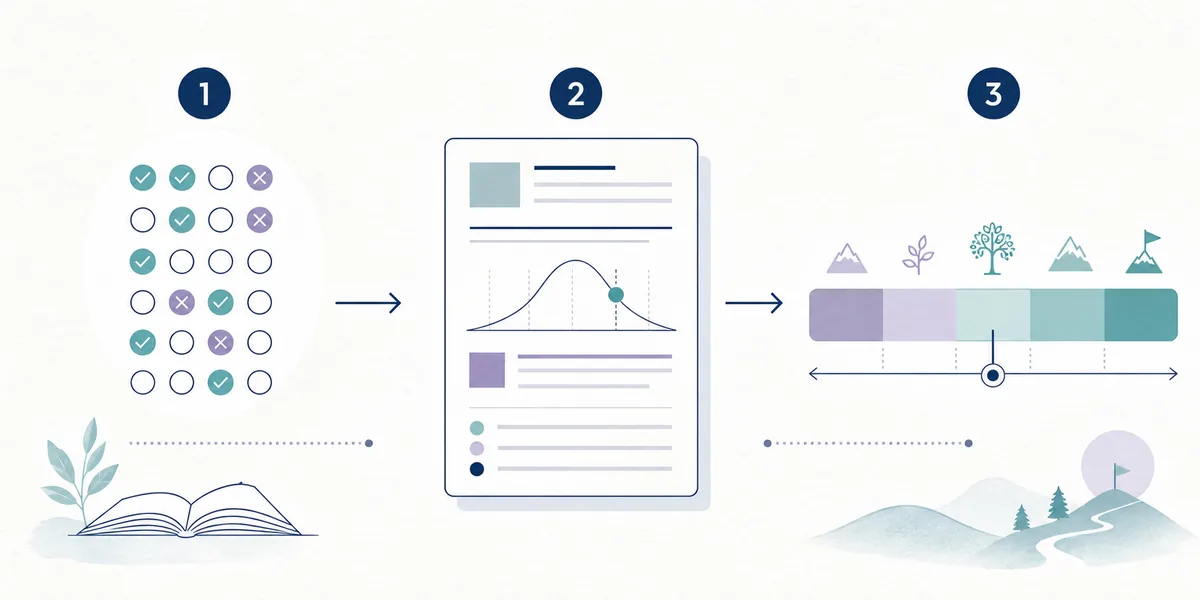
A range is often more honest than a single point estimate. It acknowledges that a practice assessment and a future licensing exam are not identical events, and that any conversion model has uncertainty. The farther a result is from your planning threshold, the easier it is to make a calm next-step decision; a borderline result deserves more evidence.
A trend is useful when the inputs are reasonably comparable. Record several recent assessments, avoid counting the same form twice as new evidence, and pay attention to whether the direction is stable or driven by one unusually high or low result.
Do not use a trend to hide a persistent weakness. If the overall estimate improves while one important content area remains weak, combine the trend with targeted review. If results are flat, changing the study method may be more useful than refreshing the same conversion table.
- Comfortably above the planning threshold with a stable trend: maintain review and verify readiness with your program’s process.
- Near the threshold or with a wide range: collect another comparable data point and review the uncertainty before scheduling.
- Below the threshold or declining: give yourself a concrete study block, review missed concepts, and reassess rather than guessing from one percentage.
Use the current official passing standard as the reference
Passing standards and reporting policies can change. When your result is close to the line, check the current official USMLE information and your program’s requirements instead of relying on an old forum post or a recycled screenshot.
The goal is not to find a number that guarantees a pass. The goal is to make a decision with current information, a realistic margin, and a plan for what you will do if the next result is different.
When to use a calculator or predictor
Use a calculator when you have one form and want to organize wrong answers, percent correct, and a directional estimate. Use a predictor when you have two to five recent NBME or UWSA results and want to see how recency and the overall trend affect a planning range.
Use the broad Step 2 CK calculator for a form-specific conversion workflow, and use the Free 120 calculator when your input is a Free 120 percentage rather than an NBME form. These pages have different boundaries; choosing the closest input type is more useful than forcing every result into the same table.
If your question is “what does this report mean?” rather than “what does this input calculate to?”, return to this guide and the official reference pages. A calculation can be correct while the decision built on it is still too confident.
A practical order of operations
First save the original report. Second calculate or verify percent correct. Third compare the result with the assessment’s own score context. Fourth, if useful, place the value beside other recent results in a trend tool. Only then decide what to study or whether to ask your program about scheduling.
This order reduces the chance that a calculator output becomes the only evidence you look at. It also makes your notes easier to audit when a later result does not match your expectation.
Common mistakes when scoring Step 2 NBME results
Most scoring errors are not difficult math errors. They are boundary errors: using the wrong denominator, mixing forms, treating a model estimate as official, or making a high-stakes decision from a single noisy result.
Before you compare results, write down the form, date, item count, incorrect count, percent correct, reported score, and source of any conversion. If one field is missing, mark it unknown instead of filling it with a guess.
The most useful interpretation is usually the one that leads to a specific next action: review a topic, repeat a measurement after enough study, ask for an advisor’s input, or keep your current plan.
- Calling percent correct an official three-digit score.
- Using the number of questions on a different form as the denominator.
- Comparing a recycled form with a new form as if they were independent data points.
- Ignoring the score range because the midpoint looks reassuring.
- Treating a single practice result as a guarantee or a failure verdict.
- Using an old passing standard without checking the current official policy.
FAQ about how to score Step 2 NBME
The practical takeaway
To score Step 2 NBME results responsibly, calculate the percentage carefully, preserve the exact assessment context, read the official report, and use ranges and trends for planning. The number is evidence for a decision, not a guarantee of what will appear on the official Step 2 CK result.
Ready to organize your next result?
Choose the tool that matches your input: one Step 2 NBME form, several recent results, or a Free 120 percentage.
Official references for score context
These first-party sources provide the surrounding exam and self-assessment context. They do not endorse this independent calculator or predictor.