How to Review NBME Mistakes for Step 2 CK
A practical, time-boxed workflow for finding why an answer went wrong and turning the pattern into your next study block.

To review NBME mistakes, save the original report, review incorrect questions first, write the tested concept and the reason your choice failed, then assign one small corrective action. After that, scan guessed-correct questions, group the tags by system or skill, and schedule a short mixed block to test the change. This is a study workflow, not an official NBME scoring rule, and it cannot guarantee a higher score.
The useful question after an NBME is not only “What was my score?” It is “What did this attempt teach me about my knowledge, reasoning, and test process?” How to review NBME mistakes well means preserving enough context to compare the attempt later, working through errors in a repeatable order, and stopping before review becomes an unfocused second textbook. The result should be a short list of actions you can test, not a notebook full of copied explanations.
How to review NBME mistakes without wasting a day
Begin after a real pause. Eat, reset, and decide how much time you can give the review before opening the answer explanations. A review block of two to four focused hours is usually easier to finish than an open promise to study until every detail feels familiar. If the assessment was split across days or heavily paused, write that down because the conditions limit how confidently you can compare the result with a later timed form.
Open the report and the questions together. For each miss, try to answer the question again before reading the explanation. State the decisive clue in one sentence, name the option you chose, and explain why it felt attractive. Only then read the educational objective or explanation. This small delay shows whether the problem was missing knowledge, a misread stem, a weak next-step rule, or a timing decision.
The goal is not to copy every paragraph. Capture the smallest useful correction: one rule, one discriminating clue, one calculation, or one action for the next block. Put deeper reading on a later list when it is not necessary to understand the question you just missed. A focused NBME review strategy for Step 2 CK protects time for mixed practice and spaced retrieval.
- Review incorrect questions first while the reasoning is still available in your memory.
- Write the tested concept before you open a long explanation.
- Use a time box and a parking list for topics that need deeper study.
- End the block with a short action list, not a pile of copied text.
Build a clean NBME review log
A review log makes an attempt comparable with the next one. Create one row per question or per recurring error, depending on how much detail you can maintain. At minimum record the form, date, timed or untimed condition, question number, system, tested task, your answer, correct answer, and a short reason. Add whether the answer was a confident miss, a guessed correct, or a correct answer reached for the wrong reason.
Keep the original score separate from your study interpretation. The report may contain the provider's result and performance profile; your log contains observations about your process. Do not rewrite a practice estimate as an official score. If you use a calculator or predictor later, link that output to the same form and date so you can tell which information came from the assessment and which came from an independent model.
Use consistent labels so the table can answer a question. For example, “knowledge gap” should mean you could not retrieve the rule, while “reasoning” should mean you knew the facts but selected the wrong action. A label that changes meaning every day cannot show a trend. Keep a short notes column for uncertainty rather than forcing every miss into a confident category. This is how to review NBME mistakes with evidence you can compare later.
- Assessment and form, date, pacing mode, and interruptions.
- System, presentation, task type, and the decisive clue.
- Chosen answer, correct answer, confidence, and error tag.
- One corrective action and the date when you will test it again.
| Field | Why it matters | Example |
|---|---|---|
| Context | Shows whether attempts are comparable | Form 14, timed, Nov 16 |
| Decisive clue | Prevents a vague reread | New focal deficit after trauma |
| Error tag | Lets patterns accumulate | Missed next step |
| Next action | Turns review into practice | Do 10 trauma next-step questions |
Tag the reason behind every missed question
An error tag is more useful than a subject label alone. “Cardiology” tells you where the question lived; it does not tell you what to change. Start with a small taxonomy and add detail only when the same pattern repeats. A practical set is knowledge gap, recognition gap, reasoning error, execution error, and test-condition error.
A knowledge gap means the fact or mechanism was not available. A recognition gap means you knew the fact in isolation but did not recognize the presentation. A reasoning error means you identified the issue but chose the wrong next step, sequence, or risk trade-off. An execution error covers misreading, arithmetic, or changing a correct answer without evidence. Test-condition errors include rushing, fatigue, distractions, or losing time in a block.
For each tag, write a different correction. Knowledge gaps need retrieval and a short reference. Recognition gaps need more varied stems. Reasoning errors need a decision rule and deliberate comparison of the leading options. Execution errors need a process guardrail. Condition errors need a scheduling or pacing experiment. This is the core of an NBME error analysis workflow: the tag should predict what you will do next. It is also the part of how to review NBME mistakes that turns a wrong answer into a measurable change.
- Knowledge: I did not know the rule or mechanism.
- Recognition: I knew the fact but missed the presentation or clue.
- Reasoning: I knew the problem but selected the wrong next action.
- Execution: I misread, miscalculated, or changed a sound answer.
- Conditions: timing, fatigue, interruption, or anxiety changed the process.
| Tag | Diagnostic question | Corrective action |
|---|---|---|
| Knowledge | Could I state the rule before seeing the answer? | Create a retrieval prompt and review it tomorrow |
| Recognition | Did the stem look different from my memorized example? | Solve varied examples and name the clue |
| Reasoning | Did I choose the wrong step or risk trade-off? | Write a one-sentence decision rule |
| Execution | Did I misread or rush a known task? | Add a final stem and unit check |
| Conditions | Did the session change how I worked? | Repeat a timed block with one pacing rule |
Review incorrect, correct, and guessed questions in order
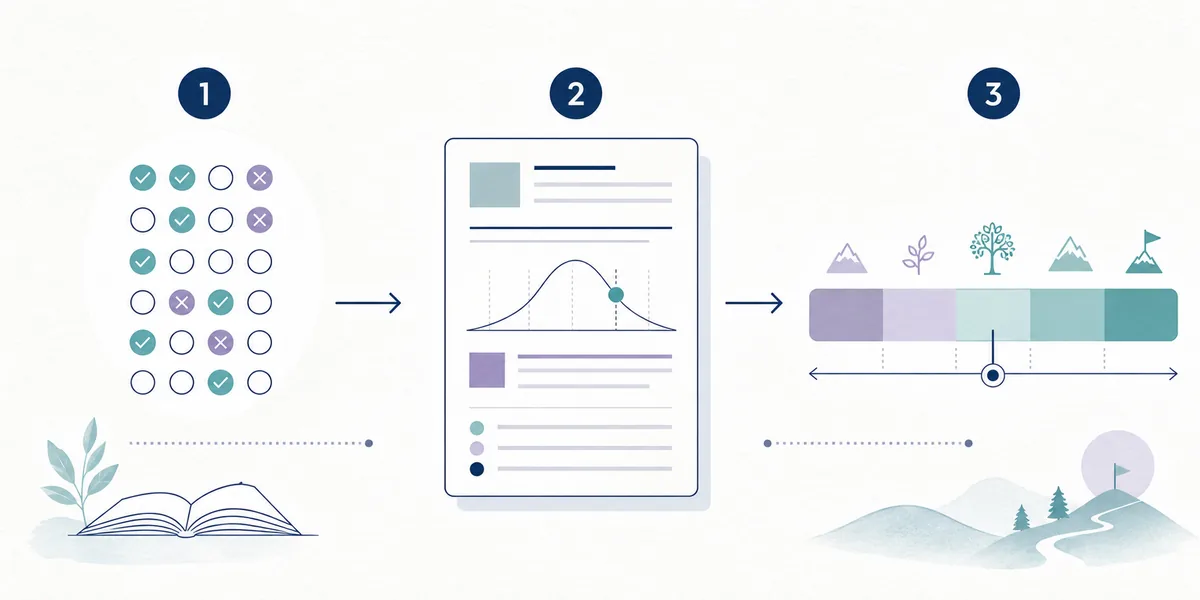
Start with incorrect answers because they contain the clearest opportunity for change. Attempt the item again, state the clue, reveal the explanation, and record one tag. When a question exposes a broad topic, put the extra reading on the parking list. Do not let one miss expand into an hour of unrelated notes before you have reviewed the rest of the form.
Next scan correct answers that were guesses or felt unstable. A correct answer reached by elimination can hide the same knowledge or reasoning gap as a miss. Mark these as “lucky correct” or “uncertain correct” and review them briefly. You do not need to recreate the whole explanation; check the clue, the competing option, and the rule that would make the answer reliable next time.
Finish with a fast pass over confident correct answers. The purpose is calibration, not perfection. Look for repeated topics, surprising wording, or an answer you got right for a fragile reason. A useful rule is to spend the most time where the tag changes your next action, not where the explanation is longest. This answers what to do after an NBME practice test without turning review into passive rereading. Use the same order each time you ask how to review NBME mistakes.
- Pass 1: every incorrect item, with a fresh attempt before the explanation.
- Pass 2: guessed or unstable correct items, limited to the decisive rule.
- Pass 3: confident correct items, scanned for repeated wording or hidden gaps.
- Close: count tags and choose no more than three priorities for the week.
Use a parking list for deep dives
Write down the topic, the question number, and the reason it needs a deeper look. Return to that list after the first pass. If the same topic appears several times, promote it to a study priority. If it appears once and the explanation is clear, a short retrieval prompt may be enough. The parking list protects the review order while still preserving useful curiosity.
Set a stopping rule before you begin: for example, two focused hours today and one short follow-up tomorrow. When the timer ends, save the unanswered list and move to the plan. A review that finishes with a small, testable action is more valuable than a perfect archive that leaves no time to practice.
Turn error tags into a one-week Step 2 CK study plan
Count tags by system and by process. A large number of knowledge tags in one system may justify a focused content block, while several reasoning tags across systems may call for mixed questions and slower review of the decision point. Do not schedule every topic that appeared once. Choose the few changes that are both frequent and actionable, then reserve time to test whether the change works.
Build the week around retrieval, application, and a check. On day one, write or review the small rules from the highest-priority tags. On days two through four, use mixed questions that require the same decision in different presentations. On day five, review the error log without rereading every explanation. On day six or seven, complete a short timed block and add only new patterns to the log.
Keep the next assessment separate from the plan's success criteria. You are testing a process change, not trying to force a target number. A good plan says what you will retrieve, how many questions will show the skill, and what evidence will make you keep or change the method. If you have several comparable three-digit results, the NBME Score Predictor can organize a trend, but it cannot tell you which error tag to study. That keeps how to review NBME mistakes focused on learning rather than on chasing a single number.
- Select up to three priorities using frequency, severity, and actionability.
- Pair each priority with retrieval prompts and mixed application questions.
- Schedule one short timed check instead of taking another full form immediately.
- Record what changed and what stayed difficult before choosing the next assessment.
| Review signal | Study response | Check |
|---|---|---|
| Repeated knowledge tags | Retrieval prompts plus a focused content block | Recall the rule without notes |
| Reasoning tags across systems | Mixed questions with a written next-step rule | Explain why the leading alternative is wrong |
| Execution or pacing tags | Timed blocks with one process guardrail | Compare time and late changes |
| Mostly stable performance | Maintain the plan and review only new patterns | Use a comparable result when ready |
Avoid common NBME review mistakes and limits
The most common failure is confusing more notes with better learning. Copying every explanation can feel thorough while hiding the decision you actually need to change. Another failure is reviewing only incorrect questions and never checking lucky correct answers. A third is using a single practice result to make a high-stakes scheduling decision without checking the report, conditions, trend, and current official requirements.
Keep the boundary visible: this article describes a study method, not an NBME policy or a clinical rule. The site's calculators and predictor are independent educational tools. They can organize inputs, ranges, and trends, but they do not reproduce official score reporting or guarantee an exam outcome. When a score is near a threshold, verify the current USMLE information and ask your program or advisor how they define readiness. That boundary is part of how to review NBME mistakes responsibly.
Finally, protect privacy and attention. Do not put identifying information in a public spreadsheet, and do not let an old error log become a permanent label. Archive the form and date, keep the action list current, and close the loop with another comparable check only after you have had time to apply the correction.
- Do not treat an independent estimate as an official score report.
- Do not create a new full-form test every time one topic feels uncomfortable.
- Do not mix recycled forms, different pacing conditions, and new forms without labeling them.
- Do not publish a spreadsheet containing names, identifiers, or private score reports.
FAQ about how to review NBME mistakes
Make the next NBME more informative
A strong NBME review preserves context, labels the reason for each miss, checks unstable correct answers, and ends with a short experiment for the next week. Keep arithmetic, provider reports, independent estimates, and study observations separate so one number does not carry more certainty than it deserves.
Continue with the right planning tool
After you finish the review log, choose the tool that matches the next decision: organize several comparable results, schedule the week, or check one Step 2 CK calculation.
Sources and scope
The workflow is educational planning guidance. Use the current provider report and official USMLE information for score and policy questions.