NBME Form 34 Score Interpretation: How to Read Your Results
A source-aware way to read a Form 34 result, understand its limits, and choose a sensible next step.

For NBME Form 34 score interpretation, start with the exact product and exam track shown in your report. Record the reported result, percent correct, performance profile, and any stated range or readiness language. Treat an online conversion as an independent planning estimate, not an official NBME or USMLE score. Use the result with recent comparable assessments and a concrete study decision rather than treating one number as a guarantee.
Searches for NBME Form 34 score interpretation mix several jobs: understanding the report, calculating a raw percentage, and deciding what to study next. This guide keeps the arithmetic, official report, and planning decision separate so a useful result does not become an overconfident claim.
What an NBME Form 34 result actually means
Form 34 is one assessment form, not a universal score scale for every NBME product. The first interpretation question is therefore not whether a number looks high or low. It is which self-assessment family, exam track, timing mode, and report format produced the number. A Step 1 style report and a Step 2 CK style report can use different labels and different score contexts.
The NBME describes its self-assessments as educational tools that provide performance feedback, relative strengths and weaknesses, and, for some products, a score interpretation guide. That guidance belongs to the assessment you took. A public table or calculator may be useful for planning, but it cannot recreate the NBME equating process or change an independent estimate into an official result.
- Confirm the assessment family and exam track before comparing the result with another form.
- Use the report supplied for your purchase as the primary source for the assessment-specific interpretation.
- Label any community conversion, range, or readiness band as an independent estimate.
- Write down the decision you are making: continue studying, change resources, take another assessment, or discuss timing.
Identify the product before reading the number
A form number alone is not enough context. Save the product name, form label, date completed, timing mode, and report version. If the result came from a shared document, verify that it belongs to Form 34 and the correct assessment family.
How to read the NBME Form 34 report
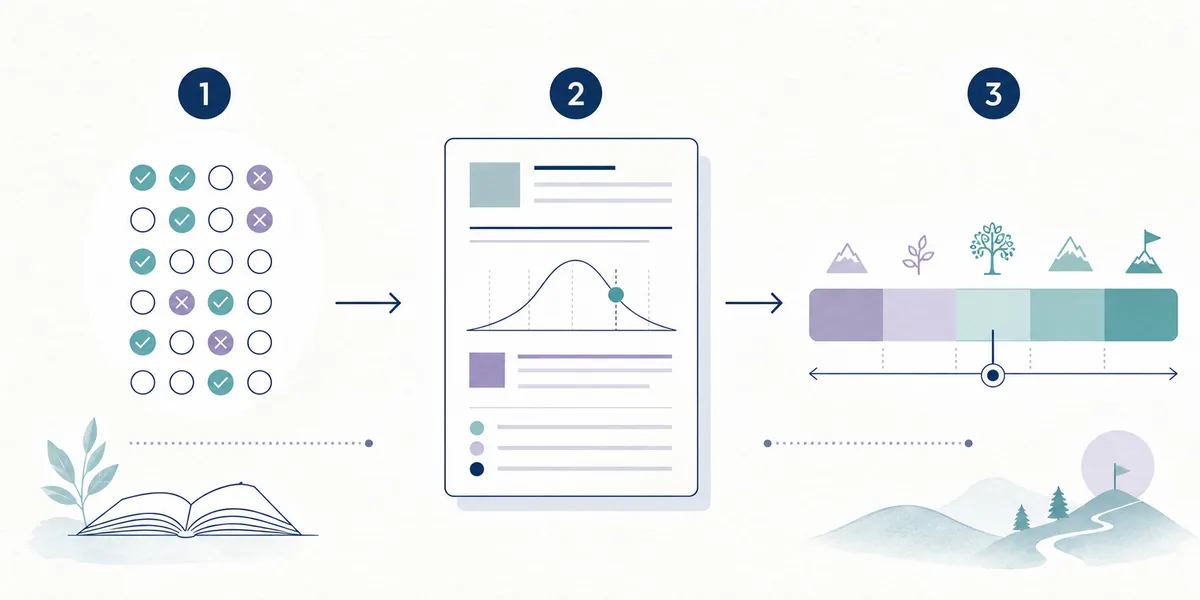
Read the report from top to bottom before opening a conversion table. Start with the overall result and the exact wording used by the provider. Then review the performance profile, content-area feedback, and any interval or interpretation guide. The labels matter because a band that overlaps another band may represent similar performance even when the plotted positions look slightly different.
The official sample report explains that performance profiles show relative strengths and weaknesses and that measurement precision differs by content area. A single weak-looking bar is a prompt for review, not proof that an entire discipline is unusable.
A self-assessment can inform preparation, but it is not an official USMLE transcript and does not guarantee a future exam result.
- Overall result and the provider's exact readiness wording.
- Percent correct or other raw performance value, if shown.
- Performance profile bands and the content areas they describe.
- Any score interpretation guide, range, confidence language, or limitations printed with the report.
How to read performance bands
A performance band is a visual summary, not a precise measurement of every topic. Wider bands indicate more uncertainty, and overlapping bands may represent similar performance. Use the profile to choose review priorities, then check whether the same weakness appears in another comparable assessment.
Percent correct is not the same as a scaled score
If you need the arithmetic, calculate percent correct as (scored items minus incorrect scored items) divided by scored items, multiplied by 100. Check the denominator in the report first. Omitted items, experimental items, or a different product format can make a remembered question count unsuitable for a hand calculation.
For example, 34 incorrect answers out of 200 scored items gives 83% correct. That example demonstrates the arithmetic only. It does not tell you an official Form 34 scaled score, a guaranteed USMLE score, or a pass probability. Keep the unrounded value in your study log and label the result as raw percent correct.
A scaled estimate is a separate model that may use form-specific observations, a regression, or a community table. Those sources can disagree, especially near the ends of a range. Use the wording estimate, range, or planning signal, not official conversion.
- Use the scored-item denominator shown by the assessment, not the number of questions you remember.
- Keep percent correct, the report's score, and an online estimate in separate columns.
- Record the source and date of any conversion table because public tables can change.
| Example | Scored items | Incorrect | Raw percent correct |
|---|---|---|---|
| A | 200 | 34 | 83% |
| B | 200 | 48 | 76% |
| C | 184 | 28 | 84.8% |
Why a generic table can mislead
A table assembled from student reports may combine products, dates, and testing conditions. It can show a broad relationship, but it is not the official scoring key for Form 34. Prefer the report's own interpretation guide over a screenshot circulating online.
Turn the Form 34 result into a study plan
A score becomes useful when it changes a specific action. If the performance profile points to a repeated content gap, schedule a short review block and a set of new questions that tests the same reasoning skill. If the result is near your program's scheduling threshold, collect another comparable data point instead of making a date decision from one uncertain estimate.
Compare Form 34 with assessments that share the same exam track and similar conditions. Note the time between assessments, repeat exposure, and interruptions. A trend is more informative when the inputs are comparable.
- Above your planning threshold with a stable trend: keep the current plan and verify the official requirements.
- Near the threshold or with a wide range: gather one comparable result and review the uncertainty before scheduling.
- Below the threshold or trending down: name the content and process gaps, change the study action, then reassess after enough time.
- Any result with unusual conditions: record the context and avoid treating it as a clean baseline.
Use multiple forms without double-counting evidence
Taking the same form again can measure recall as well as knowledge. Mark repeat attempts clearly. A predictor can organize two to five recent inputs, but its output remains a model-based planning range.
Mistakes that distort NBME Form 34 interpretation
The most common errors are boundary errors rather than difficult math. People use a denominator from another form, copy a three-digit value from an unofficial table, or treat a readiness label as a promise about the licensing exam. A careful record prevents most of these mistakes before they spread into a study plan.
Do not compare a Step 1 pass/fail-style report with a Step 2 CK three-digit estimate as if they were the same measurement. Do not assume that a newer form must be harder or easier without evidence. Form order is not a difficulty scale, and a single student's result cannot establish one.
When the result feels surprising, investigate the conditions first: timing, interruptions, sleep, unfamiliar content, or a calculation error. Then decide whether the next action is more review, another comparable assessment, or a request for guidance. The goal is a better decision, not a more dramatic label.
- Calling a community estimate an official NBME or USMLE score.
- Using a percentage from a different assessment family or denominator.
- Treating one performance band as a diagnosis of every topic in a discipline.
- Averaging unrelated forms without recording conditions.
- Using an old passing standard without checking the current official source.
- Scheduling or postponing from a single uncertain number.
When a calculator or predictor helps
Use a calculator for arithmetic with a confirmed denominator. Use a predictor for a cautious trend from several comparable results. Use this interpretation guide when the task is meaning: separating the official report from an estimate and identifying missing evidence.
- Arithmetic question: record the raw percent correct.
- Comparison question: review a trend from comparable inputs.
NBME Form 34 score interpretation FAQ
A safer way to use the result
NBME Form 34 score interpretation works best as a sequence: identify the product, read the report, confirm the denominator, label estimates honestly, and connect the result to a specific study decision.
Ready to organize your next result?
Choose the page that matches your task: read the report, check raw arithmetic, or compare several recent assessments.
Primary sources for score-report context
These first-party sources explain NBME self-assessment feedback and score-report limits.