NBME vs UWSA Step 2 CK: Which Self-Assessment Should You Take?
Compare what each assessment is designed to measure, how to schedule it, and how to respond when the scores disagree.

Choose an NBME when you want an assessment built around NBME content specifications and a report that connects to the NBME or USMLE score context for your exam track. Choose a UWSA when you want UWorld's question style, a full-length practice experience, or another independent data point. Neither result is a guarantee. For a final readiness decision, use the latest comparable result, the report's own interpretation, your testing conditions, and your recent trend together.
NBME vs UWSA Step 2 CK: compare the job each assessment does
This NBME vs UWSA Step 2 CK guide compares two practice jobs rather than declaring one winner. An NBME Comprehensive Clinical Science Self-Assessment is designed around the clinical content and reporting context of USMLE Step 2 CK. NBME describes it as a practice assessment that helps students evaluate readiness, target strengths and weaknesses, review explanations, and estimate an approximate score on the USMLE scale. The exact form, report, and current product page are the source of truth for those details.
A UWSA is a UWorld self-assessment. Its value is the UWorld question-writing style, a long timed practice experience, and an additional score signal from a different provider. That makes it useful for rehearsing endurance and for checking whether your performance is consistent across sources. It does not make the UWSA score an official USMLE result, and an online conversion table cannot turn either practice result into a guaranteed exam score.
Name the decision first. Use an NBME for exam-track context, a UWSA for a different timed practice signal, and a calculator for raw arithmetic.
- NBME question: how does my performance look in the assessment family and score context I am preparing for?
- UWSA question: how does my performance look on a different provider's full-length practice experience?
- Planning question: do multiple, comparable results support the same next action?
- Official-score question: what does the current provider report say, separate from an independent estimate?
| Decision factor | NBME | UWSA |
|---|---|---|
| Primary role | NBME-style readiness and diagnostic feedback | UWorld-style practice and an additional score signal |
| Best for | Matching the exam track and reading the NBME report | Rehearsing long timed blocks and checking source-to-source consistency |
| Output | Provider report, explanations, and assessment-specific score context | UWorld report and an independent practice estimate |
What an NBME is useful for
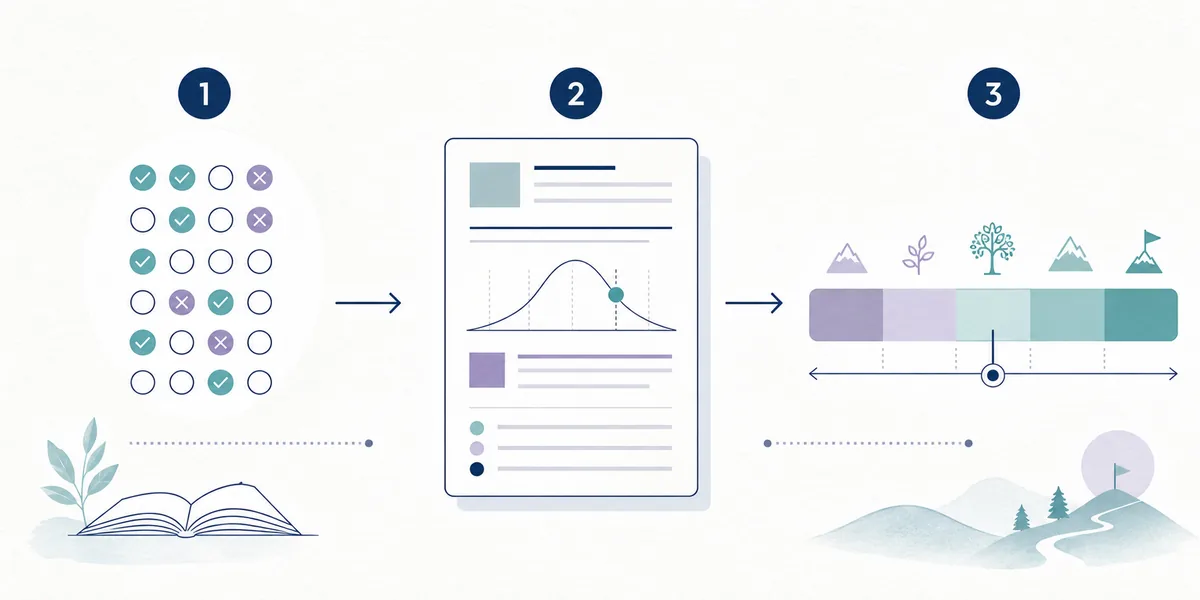
For an NBME vs UWSA Step 2 CK decision, NBME is the closer fit when your main question is readiness for the Step 2 CK exam track. The current Comprehensive Clinical Science Self-Assessment page describes multiple forms with 200 multiple-choice questions, four sections of 50 questions, and standard-paced or self-paced options. It also describes diagnostic feedback, answer explanations, and a score report that uses the USMLE Step 2 CK scale context. Confirm the current format and price on NBME's own page because products and delivery details can change.
Read the exact assessment name, form, date, pacing mode, interpretation language, performance explanations, and comparison group before comparing it with anything else. A sequence of comparable forms can show whether a weakness is persistent or whether one result was affected by fatigue or timing.
- Use the assessment-specific report before a community conversion table.
- Record the form, exam track, date, pacing mode, and testing conditions.
- Use the performance profile to choose topics for review, not to label an entire discipline.
What a UWSA is useful for
A UWSA can add information when you want a long, timed practice experience written in the UWorld environment. UWorld's Step 2 CK materials emphasize clinical scenarios and practice questions, while the self-assessment gives you a separate report from the same learning ecosystem. Students often use it to rehearse pacing, stamina, and decision-making across a full session rather than to perform a quick percent-correct calculation.
Because the provider, wording, interface, and question style differ from NBME, a gap may reflect content mix, phrasing, time pressure, repeat exposure, or the day you tested. Treat the UWSA as a second measurement, not a correction key for an NBME.
- Use a UWSA for a different provider's question style and a full-length rehearsal.
- Review pacing and fatigue, not only the final number.
- Label informal prediction claims as community evidence, not official calibration.
Choose by timing and study goal
The right order depends on what you are trying to learn. Early in preparation, use an assessment that gives you enough diagnostic detail to identify gaps and create a review plan. In the middle of preparation, alternate content review with a timed practice experience so you can see whether knowledge transfers under pressure. Near the exam, preserve a realistic schedule and choose the source that best answers your remaining uncertainty instead of taking every form without a review plan.
Budget and availability also matter. Products can have different prices, access windows, forms, and delivery rules, so check the provider's current page before purchasing. Leave enough time between assessments to review the previous one.
- Need exam-track alignment: choose the current NBME product and read its report.
- Need a different style or stamina rehearsal: schedule a UWSA with a review block afterward.
- Need a trend: use two to five comparable results and note the date and conditions.
| Your question | Better first choice | What to do with the result |
|---|---|---|
| Am I prepared for the Step 2 CK content and report context? | NBME | Read the report and identify repeated content gaps |
| Can I sustain performance in a different full-length format? | UWSA | Review pacing, fatigue, and missed-question reasoning |
| Do my results agree across sources? | Whichever source fills the missing data point | Compare conditions before interpreting the gap |
How to read conflicting NBME and UWSA scores
A disagreement is a prompt to inspect the inputs, not proof that one provider is dishonest. Start with a side-by-side log: assessment name and form, date, raw result, reported score, percent correct if available, pacing mode, interruptions, sleep, and whether you had seen the questions before. Many apparent contradictions disappear when the tests are not actually comparable.
Compare the size and direction of the gap with your trend. A modest difference can be noise or improvement; a large gap under similar conditions deserves a process review. Do not average unrelated scores just to create a reassuring midpoint. Choose the action that would still make sense if the higher number were optimistic.
- NBME 238 and UWSA 255: check dates, conditions, and whether the UWSA was unusually early or the NBME unusually recent before reacting.
- Several NBMEs rising while one UWSA is flat: keep the trend and review the UWSA process data.
| Step | Question | Output |
|---|---|---|
| 1. Verify | Are the forms, exam tracks, denominators, and dates recorded correctly? | Clean comparison inputs |
| 2. Contextualize | Were timing, sleep, interruptions, and prior exposure similar? | A fair or unfair comparison label |
| 3. Trend | Do two to five recent comparable results move together? | Stable, rising, falling, or mixed trend |
Build a fair NBME vs UWSA comparison log
A simple log turns a stressful comparison into a repeatable process. Keep one row per assessment and do not overwrite the original result after a later conversion table changes. Store the provider's report, the date you took the test, and the assumptions behind any independent estimate. This makes it easier to explain a trend to a tutor, advisor, or school without relying on memory.
Keep the interpretation boundary visible: percent correct is arithmetic, a provider score is the assessment's output, and a converted Step 2 CK range is an independent planning estimate. Add the source URL and check date beside current claims, then write one time-limited next action.
- Assessment and form: NBME or UWSA, plus the exact form label.
- Raw inputs: scored items, incorrect items, percent correct, and the provider's reported score.
- Conditions: date, pacing mode, timing, interruptions, sleep, and prior exposure.
- Interpretation: provider report, independent range, and one next action.
NBME vs UWSA Step 2 CK FAQ
Make the comparison serve your next decision
NBME and UWSA are complementary practice sources. Use the NBME report for exam-track context, use UWSA for a different question style and full-length rehearsal, and use a recent comparable trend for high-stakes planning. Keep arithmetic, provider scores, and independent estimates separate so uncertainty stays visible.
Continue with the narrow tool you need
Check a score range, organize a trend, or read the longer scoring guide after you record the original assessment context.
Official and supporting references
Product formats and score-report details can change. Check the provider pages for the version you are taking, and use independent estimates only for planning context.